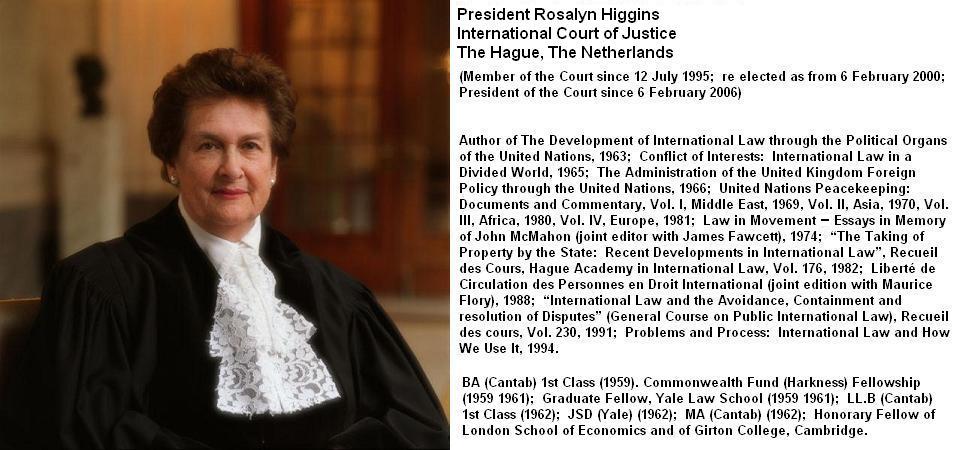
An Exclusive Interview with President Rosalyn Higgins of the International Court of Justice
by Brian Risman, Publisher and Founder, The Law Journal UK and Consultant in International Law
The Law Journal UK is honoured to have been granted an interview with President Rosalyn Higgins of the International Court of Justice, The Hague, The Netherlands.
President Higgins has a distinguished and accomplished career. She is Dame Commander of the British Empire, a Fellow of the British Academy, and a Fellow of the American Academy of Arts and Sciences. President Higgins is also a Barrister, Queen's Counsel, and a Bencher of the Inner Temple. President Higgins practiced public international law and petroleum law in the English courts, and before various international tribunals, including the International Court of Justice, the European Court of Human Rights, and the Court of the European Communities. Prior to her appointment to the Court, Dame Rosalyn was Counsel for the following cases in the International Court of Justice: case concerning East Timor (Portugal v. Australia); Territorial Dispute (Libyan Arab Jamahiriya/Chad); Questions of Interpretation and Application of the 1971 Montreal Convention arising from the Aerial Incident at Lockerbie (Libyan Arab Jamahiriya v. United Kingdom); case concerning Gabčíkovo‑Nagymaros Project (Hungary/Slovakia).
President Higgins is married to the Right Honourable The Lord Higgins, KBE, DL.
In the interview below, President Higgins talks about the direction of International Law, and gives advice to young lawyers wanting to reach for success. President Higgins also notes the value of journals such as The Law Journal UK in broadening the scope and viewpoint of the legal community
THE LAW JOURNAL UK:
President Higgins, thank you for the opportunity to interview you. May I
congratulate you on your recent award of the prestigious Balzan Prize. This
prize was given to honour you and your accomplishments in a highly distinguished
career. What do you feel are your greatest accomplishments -- and going forward,
greatest challenges?
PRESIDENT HIGGINS: Thanks so much. I feel the Award is also to be seen as an
appreciation of the work of the International Court of Justice over the years.
As you may imagine, I was surprised by the Award – just as I have been
surprised, in turn and retrospectively, to find myself President of the
International Court, to have been elected to the Court, and, even earlier, to
have been admitted to Cambridge (which changed my life). I have been fortunate
in so many things having fallen into place in my career. The only ‘achievement’
I even dared hope for was my chair at the LSE and I was very thrilled when that
came about!
The challenges, at this stage of my career and my presidency of the Court, are
to try “embed” the things I have sought to accomplish. To know that our good
relations with all courts and tribunals, our higher profile internationally, our
reputation for top quality and impartial work, and delivery of justice within
reasonable time-frames, will continue to set the agenda, is very important to
me. And it is a constant challenge for the Court to secure from the UN the
resources it needs.
It is also something of a challenge to keep up with international jurisprudence
in other courts and tribunals, and with scholarly writings – but this is
essential for the international judge.
THE LAW JOURNAL UK: What do you feel are the greatest issues facing
international law?
PRESIDENT HIGGINS: International law must provide the core predictability which
distinguishes it from politics, while at the same time showing responsiveness to
new issues and legitimate aspirations. That has never been easy, and in this
divided world seems harder than ever to achieve.
International law has to provide clear normative indications, but in doing so
never to lose sight of context.
Very much has by now been judicially determined. But there are issues that
remain contentious – examples would include the exact relationship between the
international law of immunity and the drive against impunity for major human
rights violations; the legality or otherwise of anticipatory self defence; and
whether self defence can be exercised only against states or also against
non-state actors; and the legal balance between the protection of the
environment and the right to sustainable development. Much is written on these
important matters – but how the
international judiciary deals with them over the next few years will be
crucial.
THE LAW JOURNAL UK: Your career is a model for young lawyers. What advice
would you give to those aspiring to achieve distinguished goals in their legal
career?
PRESIDENT HIGGINS: Aim high, but know that you should expect a long road of
gruelling hard work. When I was a beginner, too many young lawyers assumed they
should be satisfied with modest goals, that success was for others to achieve.
Today, with the modern confidence of the young, there is the danger that they
can expect too much, too soon – and that set-backs along the way get blamed on
others. Love your subject and immerse yourself in it.
THE LAW JOURNAL UK: Turning to the personal, what do you enjoy most in life and
your career? What could you rather do without?
PRESIDENT HIGGINS: I have loved all the different things I have done in my
career. I enjoyed research; I loved
teaching; I enjoyed human rights work, on the Committee on Human Rights under
the Covenant and elsewhere; I enjoyed
the excitement of the bar, whether in English Courts or before international
courts; and I love being a Judge. On
a more personal note, I do like the countryside, watching water-birds, being on
a golf course, having a great meal,
and the company of friends. Of course, nothing beats being with my
ever-tolerant family.
If everything came stress-free, and could be done in a few short hours of the
day, that of course would be a
bonus! But it's not the way it is.
THE LAW JOURNAL UK: What do you see as the role of International Law Journals
such as The Law Journal UK in the
development of International Law?
PRESIDENT HIGGINS: It is so encouraging that a journal such as yours has an
interest not only for the “bread and
butter” issues of such immediate importance for students, but also for
international law. Having occasional
reports and articles on international law helps busy students lift their eyes
and broaden their horizon – and there
are today great possibilities at the Bar and elsewhere for young people who want
to live an international, and not
just a national, life. Journals such as yours make an important contribution to
making such matters accessible at
an early moment in a young person's career, while career options are still open.
THE LAW JOURNAL UK: Thank you, President Higgins.
Brian Risman, Publisher and Founder, The Law Journal UK and Consultant in International Law
Latest News:
Book Review:
New Review -- Football 'Hooliganism': Policing and the War on the 'English Disease' by Dr. Clifford Stott and Dr. Geoff Pearson - Pennant Books
The Forensic Logician by Geoffrey Tøye - Starborn Books
Other Current Articles:
The Abuse Excuse -- One Size Fits All? - by James Castagnera - United States
Domestic Violence and the Problems of Poor Policing - by Karen Clark-Stapleton - UK
Foreign Investment in the Russian Federation - Denis Biryukov - Russia
Indian Legal Profession in Transition - by Kamal Wadhwa - India
For previous Articles, please click to visit our Archive.